
Ipamorelin vs GHRP-2 : Which Peptide Shows More Targeted GH Release? Growth hormone research includes peptides that influence how and

ACE-031 vs Follistatin 344 is a common comparison in myostatin research because both compounds target signalling pathways involved in skeletal muscle regulation. ACE-031 is a soluble activin type IIB receptor that binds myostatin and related ligands involved in muscle growth. Early clinical studies published in Muscle & Nerve reported increases in lean body mass following ACE-031 administration.
Follistatin 344 works differently from ACE-031. It binds to myostatin and activin proteins. This limits their interaction with activin receptors involved in muscle regulation. This difference is one reason ACE-031 vs Follistatin 344 is frequently compared in research. This is because both compounds influence muscle signalling through distinct biological mechanisms.
This article compares ACE-031 with Follistatin 344, including their mechanisms, muscle growth research, activin signalling activity, and differences in peptide structure.
Discover more about the ACE-031 effects, including the variations and formulations to buy from Direct Peptides here.

ACE-031 was designed as a soluble activin type IIB receptor that works like a decoy in myostatin research. Instead of allowing myostatin-related proteins to attach to muscle cell receptors. ACE-031 binds to those ligands first. Researchers developed this approach to reduce signalling linked to muscle growth suppression.
Early studies showed that ACE-031 targets the ActRIIB signalling pathway, which plays an important role in regulating muscle size. Blocking this pathway was associated with increases in lean body mass and thigh muscle size during early clinical evaluation.
Early research also found that ACE-031 interacts with growth-related proteins beyond myostatin, including activins, which are involved in muscle and bone biology.
Myostatin is a member of the transforming growth factor-beta (TGF-β) family and is produced mainly in skeletal muscle. Its primary role is to regulate muscle growth by limiting muscle cell development and differentiation, helping maintain normal muscle mass.
Learn more about the effects of Follistatin 344, including the various formulations available for purchase from Direct Peptides , here.

In ACE-031 vs Follistatin 344 research , Follistatin 344 binds to myostatin and activin proteins before they interact with activin type II receptors on muscle cells. Follistatin is widely recognised as a natural binding protein for several members of the TGF-β family because it limits signalling associated with muscle growth inhibition.
When myostatin and activins bind to ActRIIB receptors, they activate the SMAD2 and SMAD3 signalling pathways, which are associated with reduced muscle growth and increased muscle protein breakdown. Studies show that Follistatin 344 helps limit this process by binding to these proteins and preventing their attachment to receptors.
Researchers continue studying ACE-031 Vs Follistatin 344 because follistatin activity may affect muscle fibre growth, skeletal muscle repair, and muscle hypertrophy through wider interactions with activins and other TGF-β signalling proteins.
ACE-031 and Follistatin 344 differ in their molecular design and protein composition. ACE-031 was developed as a fusion protein comprising the extracellular domain of the activin type IIB receptor and a human IgG1 Fc domain. Researchers designed this structure to improve stability and the duration of its activity in the body during clinical evaluation.
Follistatin 344 has a distinct structure because it is a naturally occurring follistatin isoform encoded by the FST gene. FS344 serves as a precursor, processed into the circulating FS315 isoform found in blood and other tissues.
These structural differences distinguish ACE-031 from Follistatin 344 at the protein level and influence how their biological activity is investigated in skeletal muscle and TGF-β signalling pathways.
Researchers distinguish ACE-031 and Follistatin 344 based on pathway selectivity, protein design and research use. Current studies also highlight differences in their developmental histories, ligand-targeting ranges, and effects on downstream signalling activity.
| Feature | ACE-031 | Follistatin 344 | Research Focus |
| Development Type | Engineered biologic | Naturally occurring follistatin isoform | Protein signalling research |
| Ligand Coverage | Primarily ActRIIB-related ligands | Broad TGF-β family interactions | Activin and myostatin pathways |
| Research Progression | Clinical evaluation completed | Mostly molecular and preclinical studies | Skeletal muscle regulation |
| Downstream Activity | Indirect signalling inhibition | Direct protein neutralisation | Muscle preservation pathways |
Explore Peptide Supplies at Direct Peptides for all your reconstitution requirements.
ACE-031 has not been approved for medical use and remains a discontinued investigational compound following early clinical studies. Its development ended after safety concerns were identified. Because it targets the myostatin/ActRIIB pathway, ACE-031 is prohibited under the World Anti-Doping Agency (WADA) rules.
Comparing ACE-031 with Follistatin 344 highlights two different approaches to muscle signalling. Each compound acts through a separate pathway, resulting in different patterns of biological activity.
Both compounds are available for controlled scientific research. Comparing their signalling behaviour, interaction range and biological response over time helps researchers better understand their activity in experimental models.
These ongoing evaluations continue to shape researchers’ views of pathway modulation and the assessment of different protein-based approaches in future experimental studies.
Visit Direct Peptides to discover a wide range of premium-quality research peptides today!
(1) Pearsall RS, Davies MV, Cannell M, Li J, Widrick J, Mulivor AW, Wallner S, Troy ME, Spaits M, Liharska K, Sako D, Castonguay R, Keates S, Grinberg AV, Suragani RNVS, Kumar R. Follistatin-based ligand trap ACE-083 induces localised hypertrophy of skeletal muscle with functional improvement in models of neuromuscular disease. Sci Rep. 2019 Aug 6;9(1):11392.
(2) Lee SJ, Bhasin S, Klickstein L, Krishnan V, Rooks D. Challenges and Future Prospects of Targeting Myostatin/Activin A Signalling to Treat Diseases of Muscle Loss and Metabolic Dysfunction. J Gerontol A Biol Sci Med Sci. 2023 Jun 16;78(Suppl 1):32-37.
(3) Schumann C, Nguyen DX, Norgard M, Bortnyak Y, Korzun T, Chan S, Lorenz AS, Moses AS, Albarqi HA, Wong L, Michaelis K, Zhu X, Alani AWG, Taratula OR, Krasnow S, Marks DL, Taratula O. Increasing lean muscle mass in mice via nanoparticle-mediated hepatic delivery of follistatin mRNA. Theranostics. 2018 Oct 22;8(19):5276-5288.
Yes. ACE-031 increases muscle mass in research settings by blocking myostatin and related growth-inhibiting ligands. Preclinical studies and early clinical data show increases in lean body mass and muscle volume. These effects occur through reduced inhibitory signalling and enhanced muscle protein synthesis within skeletal muscle tissue.
ACE-031 is prohibited under the World Anti-Doping Agency (WADA) Prohibited List because of its mechanism of action. WADA also prohibits other substances that act through similar biological pathways, even where individual compounds are not specifically named.
Preclinical studies have examined Follistatin 344 in relation to muscle regeneration following injury. Its interaction with myostatin and activin signalling has been associated with processes involved in muscle cell differentiation and tissue repair in experimental models. Human evidence remains limited.
Follistatin 344 has been studied in relation to skeletal muscle biology, and changes in muscle tissue may influence metabolic processes. Most of the available evidence comes from animal and laboratory studies, while human clinical data remain limited.
ACE-031 and Follistatin 344 work through different biological mechanisms, so direct comparisons are difficult. ACE-031 acts as a decoy receptor for myostatin and related ligands, whereas Follistatin 344 binds myostatin and several members of the TGF-β family. At present, there are no head-to-head clinical studies showing that one is superior to the other.

SALE
ACE-031 Nasal Spray
Price range: £73.09 through £143.39 Select options This product has multiple variants. The options may be chosen on the product page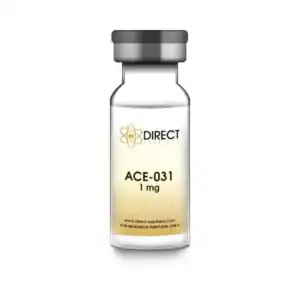
SALE
ACE-031 Peptide Vial
Price range: £67.49 through £76.74 Select options This product has multiple variants. The options may be chosen on the product page
Follistatin 344 Peptide Vial
Price range: £117.98 through £124.78 Select options This product has multiple variants. The options may be chosen on the product page
Follistatin 344 Nasal Spray
Price range: £96.69 through £188.38 Select options This product has multiple variants. The options may be chosen on the product pageIpamorelin vs GHRP-2 : Which Peptide Shows More Targeted GH Release? Growth hormone research includes peptides that influence how and

How Orexin A Peptide May Impact Mood, Energy, and Focus? Orexin A Peptide is a neuropeptide that researchers study for

The Synergy of Semax and Selank : A Breakthrough in Peptide Therapy Peptide therapy is becoming an important part of

How Do Peptides Work for Wound Healing, Tissue Regeneration And Promote Recovery? Peptides have been investigated for their potential influence