
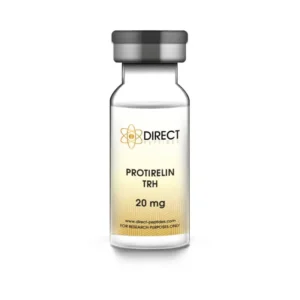
Buy Protirelin TRH Peptide
Protirelin TRH peptide is a synthetic thyrotropin-releasing hormone, a natural brain hormone that regulates thyroid function. Its main proven benefit is helping doctors diagnose thyroid and pituitary disorders. However, it has also shown some additional experimental effects on alertness, central nervous system activity, and neuroprotection.Shop our Full Range of Protirelin TRH Peptides
-
NEWProtirelin TRH Peptide Vial
ÂŁ32.08 – ÂŁ41.06Price range: ÂŁ32.08 through ÂŁ41.06 This product has multiple variants. The options may be chosen on the product page
What is Protirelin TRH?
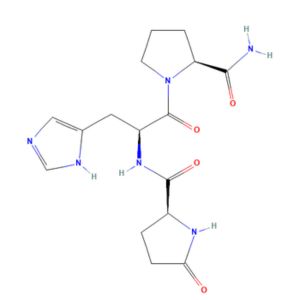
Protirelin, also known as Thyrotropin-Releasing Hormone (TRH), is a tripeptide hormone synthesised in the hypothalamus. It plays a pivotal role in the hypothalamic-pituitary-thyroid axis by stimulating the anterior pituitary to release Thyroid-Stimulating Hormone (TSH) and prolactin. Structurally, it consists of three amino acids: pyroglutamic acid, histidine, and proline.
Beyond its endocrine functions, Protirelin exhibits neuromodulatory properties, influencing mood, cognition, and neuroprotection. It is widely used in clinical diagnostics to assess thyroid and pituitary function and is being explored for therapeutic applications in neurological disorders, including depression and neurodegeneration. Protirelin’s multifunctionality makes it a significant focus in biomedical research.
Protirelin TRH Mechanism Of Action
The Protirelin TRH peptide is essential for regulating the hypothalamic-pituitary-thyroid axis. This neurohormone is created in the hypothalamus and travels through a specialized capillary network to the anterior pituitary gland.
When it reaches the pituitary gland, Protirelin binds to receptors on thyrotroph cells. This sets off a series of signals inside the cells, causing an increase in calcium levels. This process stimulates both the creation and release of Thyroid-Stimulating Hormone (TSH), which in turn signals the thyroid gland to produce thyroid hormones.
Once thyroid-stimulating hormone (TSH) is in the bloodstream, it signals the thyroid gland to produce and release triiodothyronine (T3) and thyroxine (T4). These hormones are vital for regulating metabolism, heart rate, body temperature, and energy levels.
Protirelin also acts as a neuromodulator in the central nervous system, where it can influence mood, enhance cognitive functions like learning and memory, and help protect neurons from harm. This dual impact on both the endocrine system and the brain makes Protirelin a versatile compound for both clinical applications and scientific study.

Structure of Protirelin TRH
Sequence: H-Pyr-His-Pro-NH2
Molecular Formula: C16H22N6O4
Molecular Weight: 362.38 g/mol
PubChem CID: 638678
What Are The Research Benefits of Protirelin TRH
Thyroid and Pituitary Function Research: Protirelin is best known for its role in endocrine research, particularly in studying communication between the hypothalamus, pituitary gland, and thyroid. In clinical investigations, researchers administer protirelin and then measure thyroid-stimulating hormone (TSH) release to evaluate how well the pituitary responds (1).
This type of “dynamic testing” gives scientists more insight than a single blood test because it shows how the hormonal system reacts in real time. Over the years, the TRH stimulation test has helped researchers study hypothyroidism, pituitary dysfunction, and disorders affecting the hypothalamus. Even though newer diagnostic tools are now common, protirelin remains an important reference compound in neuroendocrine research (2).
Neuroprotective and Brain Research: Researchers have studied protirelin because TRH receptors are found throughout the brain, not just in endocrine tissues. Studies suggest this peptide might help protect nerve cells during stress or injury. Experiments show that TRH signalling can lower glutamate-related toxicity, which is linked to diseases like Alzheimer’s and brain injuries (3).
Scientists are especially interested in how PI3K/AKT pathways might help nerve cells survive and repair themselves. Some research has looked at possible uses in Alzheimer’s disease, epilepsy, and spinal cord injury. Most of this research is still in early stages, but the results keep protirelin important in neuroscience and neuroprotection studies (4).
Fatigue, Arousal, and Cognitive Function Research: Early research found that Protirelin TRH can influence neurotransmitters such as dopamine and acetylcholine, which are important for attention and wakefulness. Because of this, scientists have tested protirelin and similar compounds for mental fatigue, reduced consciousness after brain injury, and some neurological disorders with slow responses (5).
Some studies reported temporary improvements in alertness and behaviour after giving protirelin. In Japan, researchers have studied protirelin analogues for recovery after head injuries and subarachnoid haemorrhage. Although the evidence is still limited and mixed, these findings keep interest in TRH-based compounds active in brain research (6).
Neuromuscular and Motor Function Research: Protirelin has also been studied for its possible effects on movement, coordination, and neuromuscular control. Researchers became interested when they found that TRH affects pathways involved in motor neuron activity and muscle response. Experiments suggest that the peptide may help nerves and muscles communicate more effectively, especially when motor function is impaired. Because of this, scientists have tested protirelin in conditions like spinocerebellar degeneration, amyotrophic lateral sclerosis (ALS), and spinal cord injury (7).
Some early clinical trials found that patients treated with protirelin showed short-term gains in walking, speaking, and muscle control. Scientists suspect these changes are linked to how protirelin affects certain signalling pathways in the brain and nervous system, especially those involving acetylcholine and dopamine. While the research so far doesn’t provide clear answers, protirelin still attracts attention among those studying ways to help people regain movement and recover from nerve-related injuries (8).
Buy Protirelin TRH for research online today!
Frequently Asked Questions (FAQs) about Protirelin TRH
Is it legal to buy Protirelin TRH peptide?
Whether or not it’s legal to buy Protirelin TRH peptide depends on your country’s laws. In the United States, for example, Protirelin TRH is not approved by the FDA for human use. However, it can be legally purchased for laboratory and scientific research. Before buying any research peptide, you should always check your local laws to ensure you’re in compliance.
Does Protirelin TRH have any adverse effects?
Protirelin TRH may cause side effects, particularly when used outside of controlled research settings. Commonly reported side effects include nausea, headaches, flushing, and changes in blood pressure. In rare cases, it may cause allergic reactions or other adverse effects. It is crucial to use Protirelin TRH under professional supervision in research environments to minimise risks and ensure safety.
Is Protirelin used in veterinary medicine?
Yes. Protirelin has an important role in veterinary endocrinology, particularly in horses. Veterinarians commonly use the TRH stimulation test to help diagnose Pituitary Pars Intermedia Dysfunction (PPID), also known as equine Cushing’s disease. During testing, protirelin stimulates hormone release from the pituitary gland, helping identify abnormal endocrine responses associated with PPID in horses (9).
What is the difference between Protirelin and Thyrotropin?
Protirelin and thyrotropin are closely connected, but they are not the same substance. Protirelin is the synthetic form of thyrotropin-releasing hormone (TRH), a peptide produced in the hypothalamus. Its role is to signal the pituitary gland to release thyroid-stimulating hormone (TSH). Thyrotropin, more commonly called TSH, is the hormone released by the pituitary gland that then stimulates the thyroid to produce the hormones T3 and T4.
Buy Protirelin TRH peptide for research purposes from Direct Peptides .
Summary of Research Applications
- Stimulates thyroid hormone release
- Supports hormonal balance
- Enhances cognitive function
- Aids neurological research
- Promotes energy metabolism
Protirelin TRH Peptide Quality Assured
At Direct Peptides , you can buy Protirelin TRH with a guaranteed purity of 99% or higher. Each batch undergoes rigorous testing to ensure it meets the highest standards of quality and effectiveness. This guarantees that you can rely on our Protirelin TRH peptide products to deliver consistent and dependable results for your research requirements.
References For Further Reading​
(1) Holaday JW, Bernton EW. Protirelin (TRH): A Potent Neuromodulator With Therapeutic Potential. Arch Intern Med. 1984;144(6):1138–1140. doi:10.1001/archinte.1984.00350180050006
(2) Paige Meizlik, MD, MSTR , Andrew Cucchiara, PhD , Lakshmi Kannan, MD MSc , Theresa Scattergood, MSN, RN , Anne Rentoumis Cappola, MD, ScM
Journal of the Endocrine Society, Volume 5, Issue Supplement_1, April-May 2021, Pages A853–A854, https://doi.org/10.1210/jendso/bvab048.1742
(3) Trubacova R, Drastichova Z and Novotny J (2022) Biochemical and physiological insights into TRH receptor-mediated signaling. Front. Cell Dev. Biol. 10:981452. doi: 10.3389/fcell.2022.981452
(4) Dong Y, Watson DJ. Thyrotropin-releasing hormone protects hippocampal neurons against glutamate toxicity via phosphatidylinositol 3-kinase/AKT pathway and new protein synthesis. bioRxiv Preprint. 2025 Nov 12:2025.11.11.687668. doi: 10.1101/2025.11.11.687668. PMID: 41292786; PMCID: PMC12642481.
(5) Alvarez-Salas E, GarcĂa-Luna C, de Gortari P. New Efforts to Demonstrate the Successful Use of TRH as a Therapeutic Agent. Int J Mol Sci. 2023 Jul 4;24(13):11047. doi: 10.3390/ijms241311047. PMID: 37446225; PMCID: PMC10341491.
(6) Shibata A, Matano F, Fujiki Y, Mizunari T, Murai Y, Yokota H, Morita A. Efficacy of Thyrotropin-Releasing Hormone Analog for Protracted Disturbance of Consciousness due to Aneurysmal Subarachnoid Hemorrhage. J Stroke Cerebrovasc Dis. 2019 Apr;28(4):988-993. doi: 10.1016/j.jstrokecerebrovasdis.2018.12.036. Epub 2019 Jan 17. PMID: 30660483.
(7) Miller SC, Warnick JE. Protirelin (Thyrotropin-Releasing Hormone) in Amyotrophic Lateral Sclerosis: The Role of Androgens. Arch Neurol. 1989;46(3):330–335. doi:10.1001/archneur.1989.00520390096025
(8) White SR, Crane GK, Jackson DA. Thyrotropin-releasing hormone (TRH) effects on spinal cord neuronal excitability. Ann N Y Acad Sci. 1989;553:337-50. doi: 10.1111/j.1749-6632.1989.tb46655.x. PMID: 2497678.
(9) Thane K, Uricchio C, Frank N. Effect of early or late blood sampling on thyrotropin releasing hormone stimulation test results in horses. J Vet Intern Med. 2022;36(2):770-777. doi:10.1111/jvim.16362
Why Choose Direct Peptides ?
Buy Protirelin TRH from Direct Peptides, your trusted source for high-purity research peptides. We are committed to scientific excellence and product integrity, offering this specialized peptide in a 20mg vial that meets strict laboratory standards.
ALL CONTENT AND PRODUCT INFORMATION AVAILABLE ON THIS WEBSITE IS FOR EDUCATIONAL PURPOSES ONLY.
DISCLAIMER: These products are intended solely as a research chemical only. This classification allows for their use only for research development and laboratory studies. The information available on our Direct Peptides website: https://direct-peptides.com is provided for educational purposes only. These products are not for human or animal use or consumption in any manner. Handling of these products should be limited to suitably qualified professionals. They are not to be classified as a drug, food, cosmetic, or medicinal product and must not be mislabelled or used as such.
Related Posts

Is Protirelin Just Used for Diagnostic Tests or Thyroid Support ?
This blog explores the role of Protirelin, a synthetic version of the thyrotropin-releasing hormone (TRH), and its uses beyond standard thyroid testing. Protirelin stimulates the hypothalamic-pituitary-thyroid (HPT) axis, which encourages the production of thyroid hormones and helps regulate metabolism. We will look at how Protirelin influences thyroid signaling, TSH release, and overall endocrine function, as well as its potential in thyroid support research. The article also touches on related peptides like IGF-1 LR3, VIP, and Thymosin Alpha-1, which are being studied for their potential to support immune regulation, metabolism, and endocrine pathways related to the thyroid.
Unlocking the Truth About Thyroid Function
This blog explores the important role of the thyroid in controlling metabolism, energy levels, and hormonal balance. It explains how the hypothalamic-pituitary-thyroid (HPT) axis manages thyroid hormone production, which affects almost every part of the body. The article also discusses peptides like Protirelin, MOTS-c, Tesamorelin, and CJC-1295, which are being researched for their ability to support thyroid signaling and energy regulation. By looking at how these peptides influence thyroid function and overall hormonal health, the blog highlights the potential of peptide research to improve metabolic and endocrine wellness.