
Mechanisms Behind Bronchogen’s Anti-Inflammatory Effects Researchers study Bronchogen as a peptide complex that influences inflammation at the cellular level in

The PEG-MGF peptide lasts longer in research environments due to a structural modification known as pegylation. Regular mechano growth factor (MGF) is a short peptide derived from IGF-1 that breaks down very quickly in solutions or biological systems due to enzymatic degradation and small molecular size. Its active form is tied to muscle repair but naturally degrades within minutes. This rapid breakdown limits its window of action in experiments.
The primary difference lies in the attachment of polyethylene glycol (PEG) chains to the peptide backbone. This chemical process increases the effective molecular size of the peptide, which allows it to persist longer in experimental systems. Larger PEG-modified molecules remain present in solution for extended periods, improving stability and allowing researchers to observe prolonged effects in studies.
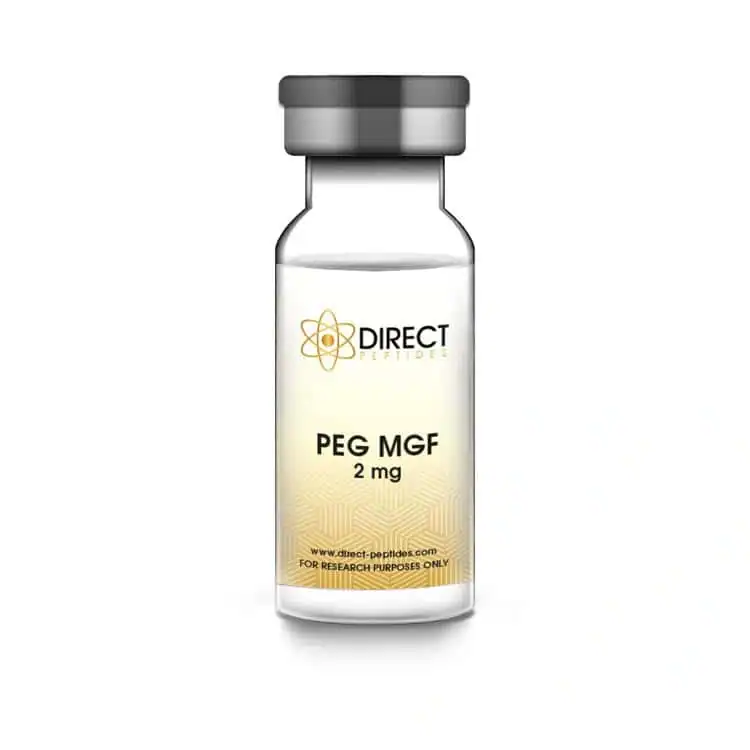
Explore PEG MGF Peptide from Direct Peptides , a PEGylated research peptide designed to improve molecular stability and persistence in experimental studies.

PEGylation prevents enzymatic breakdown by creating a steric shield around the molecule. When a PEG chain attaches covalently to a peptide, the polymer increases the molecule’s hydrodynamic radius and creates a hydrated layer. This structural change limits direct access of proteolytic enzymes to the peptide backbone, which slows the degradation process.
Research shows that PEGylated peptides and proteins resist proteolytic degradation more effectively than unmodified counterparts because the PEG layer obstructs enzyme approach and binding. This protective effect arises from PEG’s bulk and its ability to hinder interactions between proteases and peptide cleavage sites. Larger or more extensive PEG coverage generally provides stronger protection due to increased steric hindrance.
Shop MGF from Direct Peptides , a mechano growth factor peptide commonly used in research to study short-acting IGF-1 signaling and cellular response mechanisms.
The molecular weight of the PEG chain directly impacts the level of physical coverage provided. Higher molecular weight PEG occupies a larger hydrated volume, which increases steric coverage and limits molecular interactions near the peptide surface. This expanded polymer domain reduces exposure of the peptide backbone to destabilizing forces in solution, supporting greater structural persistence during experimental observation.
Lower-molecular-weight PEG provides weaker stabilization because the polymer covers less surface area, leaving more of the peptide transiently exposed. Studies comparing different PEG chain lengths show that increasing PEG molecular weight consistently correlates with longer retention and improved stability for PEGylated peptides and proteins. Therefore, researchers can adjust molecular weight to control how long the peptide maintains its integrity.
Explore Peptide Supplies at Direct Peptides for all your reconstitution requirements.
The specific location where PEG attaches to the peptide significantly influences its stability. Site-specific PEGylation, where PEG is attached at a predefined residue, produces consistent PEG-peptide conjugates with uniform stability characteristics compared with random PEGylation.
Experimental studies demonstrate that different PEG attachment locations yield different stability outcomes. Variants with PEG attached at distinct positions show measurable differences in how they resist denaturation and proteolytic challenges, making attachment site selection critical for maintaining structural stability.
Modern research into PEGylation effects also shows that attachment site influences how PEG interacts with the peptide structure. Site-specific placement can support conformational stability and protection from breakdown under experimental conditions.

PEGylation density affects peptide stability by changing how many PEG chains surround each molecule. Studies using model proteins show that higher PEGylation density improves physical stability. When more PEG chains attach, the molecule resists structural unfolding and aggregation more effectively during experimental testing. This stability stems from the cumulative effect of multiple PEG chains.
Lower PEGylation density provides less stabilization because fewer PEG chains cover the peptide surface. Although peptides with fewer PEG attachments may retain higher residual activity, they show weaker resistance to physical destabilization. Thus, density acts as an independent stability factor, distinct from molecular weight or attachment site.
| Aspect | PEG MGF Peptide | Regular MGF |
|---|---|---|
| Structural modification | Contains covalently attached PEG chains. | Retains native peptide structure without modification. |
| Molecular size | Increased effective size and hydrodynamic radius. | Small peptide with low molecular mass. |
| Stability in experimental systems | Shows improved physical stability during handling. | Degrades rapidly without modification. |
| Resistance to degradation | Reduced susceptibility to proteolytic breakdown. | Highly susceptible to enzymatic degradation. |
| Retention and persistence | Demonstrates longer retention in research models. | Shows very short persistence. |
| Product consistency | Allows controlled and predictable experimental behavior. | Displays greater variability across experiments. |
| Stability optimization parameters | Tunable through PEG size, placement, and density. | Limited to formulation conditions only. |
Future research aims to standardize preparation protocols to ensure reproducibility. Consistent modification parameters and handling methods will improve comparability across studies and strengthen experimental outcomes.
Future studies may also focus on model selection, measurement consistency, and long-term observation methods. Improving experimental frameworks and reporting clarity can support a deeper understanding of PEG MGF peptide behavior in research systems.
[1] Kandalla PK, Goldspink G, Butler-Browne G, Mouly V. Mechano Growth Factor E peptide (MGF-E), derived from an isoform of IGF-1, activates human muscle progenitor cells and induces an increase in their fusion potential at different ages. Mech Ageing Dev. 2011 Apr;132(4):154-62.
[2] Santhanakrishnan KR, Koilpillai J, Narayanasamy D. PEGylation in Pharmaceutical Development: Current Status and Emerging Trends in Macromolecular and Immunotherapeutic Drugs. Cureus. 2024 Aug 12;16(8):e66669.
[3] Fornasari DMM. PEGylated Proteins: How Much Does Molecular Weight Matter? Clin Pharmacokinet. 2025 Nov;64(11):1587-1597.
[4] Lawrence PB, Price JL. How PEGylation influences protein conformational stability. Curr Opin Chem Biol. 2016 Oct;34:88-94.
PEG-MGF Peptide Vial
Price range: £27.00 through £35.98 Select options This product has multiple variants. The options may be chosen on the product page
PEG-MGF Nasal Spray
Price range: £35.00 through £65.00 Select options This product has multiple variants. The options may be chosen on the product page
MGF Peptide Vial 2mg
Price range: £17.54 through £26.52 Select options This product has multiple variants. The options may be chosen on the product page
MGF Pre-Mixed Pen 2mg Peptide
Price range: £23.24 through £62.75 Select options This product has multiple variants. The options may be chosen on the product pageMechanisms Behind Bronchogen’s Anti-Inflammatory Effects Researchers study Bronchogen as a peptide complex that influences inflammation at the cellular level in

The Role of the Bronchogen Peptide for Lung Tissue Research Researchers study the bronchogen peptide in laboratory models to examine

The Role of AMPK Activators in Boosting Cellular Energy AMPK, or AMP activated protein kinase, works as a central cellular

How Can Pegylated MGF Reduce Cortisol? Cortisol, often called the “stress hormone,” plays a crucial role in metabolism, immune response,